
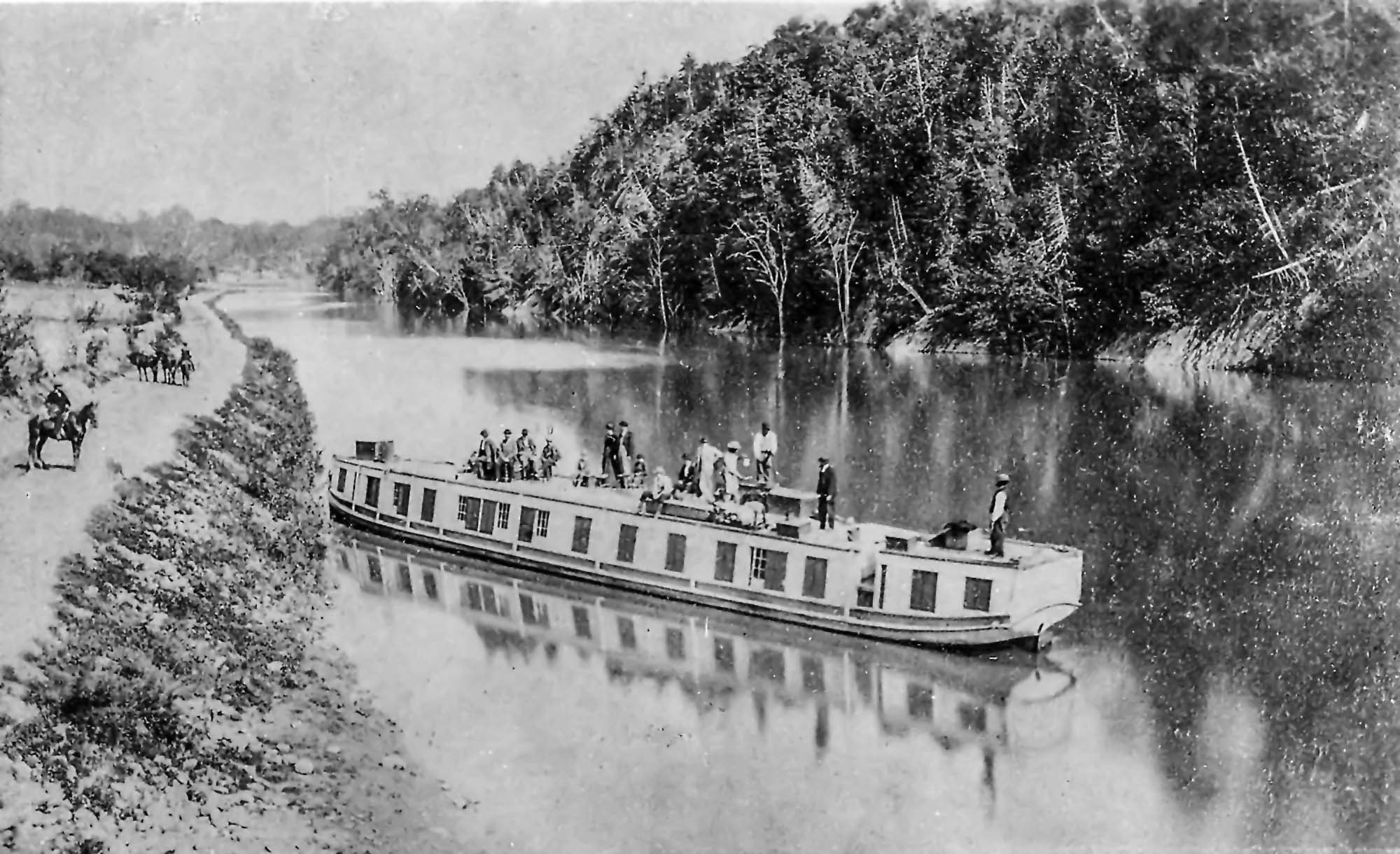

Date: ca. 1842
Image Number: JH563cdJH30
Scottsvillian Jack Hamner, an experienced ‘dirt fisherman’ (relic hunter), unearthed this packet boat baggage tag near an old stone chimney between Keene and Esmont. The tag’s front reads “BE&D Packet, 8.” Engraved on the tag’s back is “John Robbins, Boston.”
In the mid-1800’s, such small metal tags were attached to a traveler’s personal luggage and usually bore the name of the issuing party (hotel, railroad or other transportation company) along with a number by which a passenger could identify his or her luggage. At the end of one’s hotel stay or upon arrival at the desired destination, these tags usually were removed and returned to the issuing company for reuse.
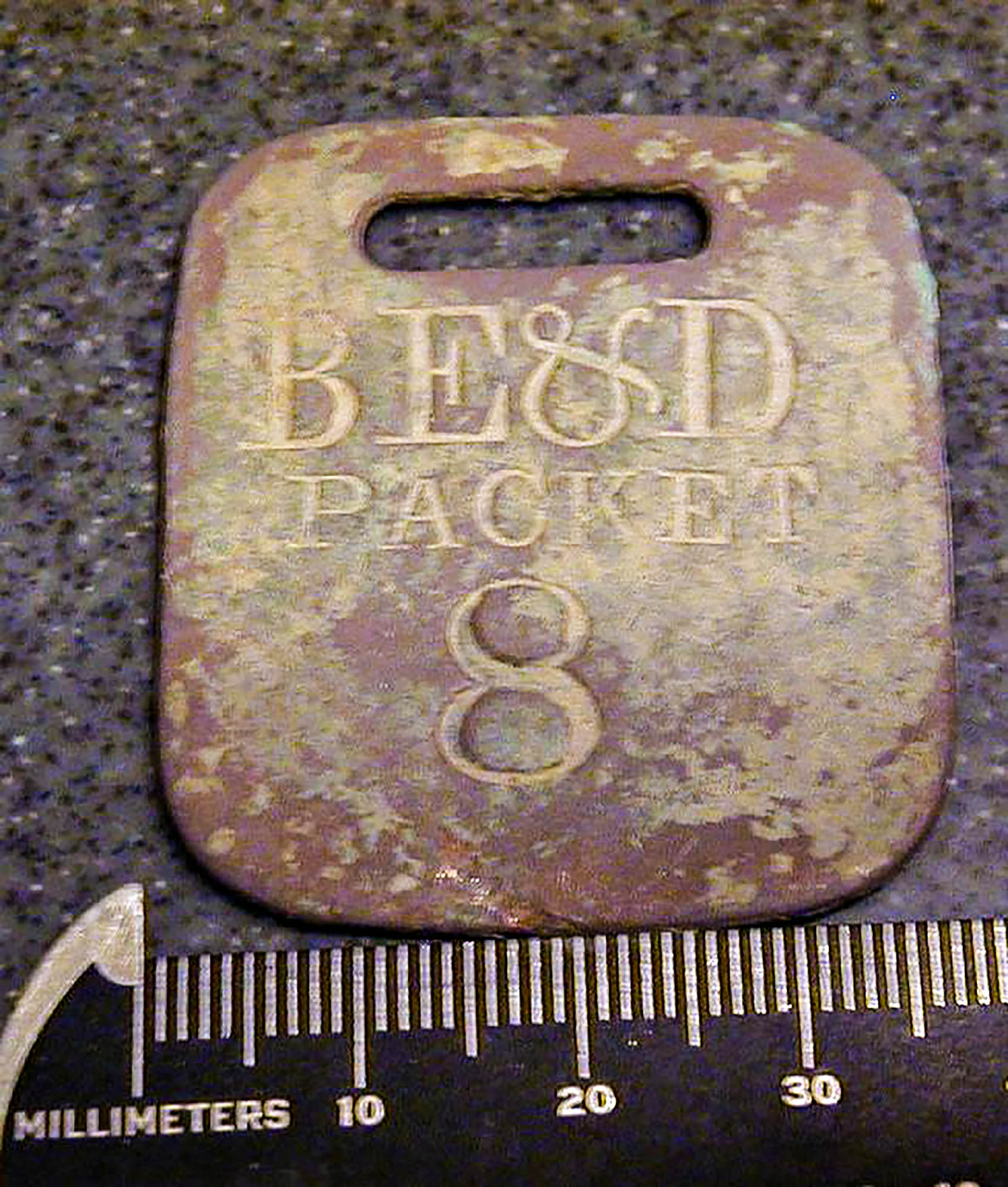
For whatever reason, this tag was not returned to the packet boat company that operated on the James River and Kanawha Canal through Scottsville. Instead, this tag ended up seven or eight miles from the Canal between Keene and Esmont, Virginia, perhaps accompanying the passenger’s bag to his home.
The BE&D initials on this baggage tag stand for the initials of Boyd, Edmond, and Davenport, the dominant packet (passenger) boat company on the James River and Kanawha Canal, which was organized in March 1842. BE&D ran a line of light packet boats that carried passengers and mail between Richmond and Lynchburg.
Two of these packet boats, the Joseph C. Cabell and the John Marshall, made three trips weekly each way. The boats traveled day and night, the trip taking about thirty-five hours at a speed of four miles per hour. Fares charged were $8.00 each way, including meals.
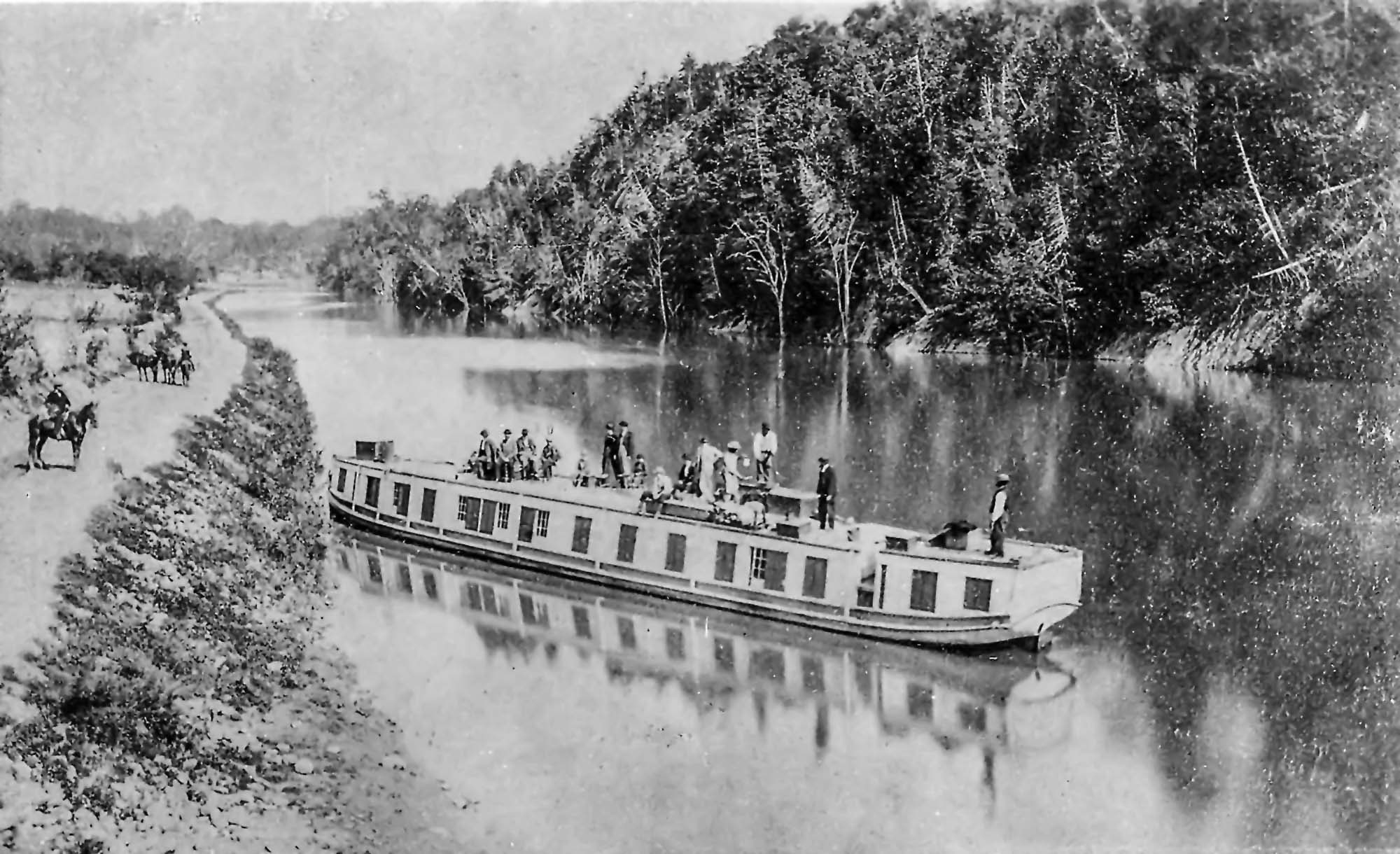
The John Marshall was regarded as the finest packet boat to travel the canal. At ninety feet long, it had a galvanized cast iron hull and hand hewn Dominican mahogany interior, with separate state rooms for ladies and gentlemen. It was chosen to transport the body of General Stonewall Jackson upriver to its final resting place in Lexington in 1863.
Passengers boarded at the company’s Richmond basin at 8 AM on Mondays, Wednesdays, and Fridays. The boats arrived at Scottsville at 1 AM the next morning and at Lynchburg at 7 PM that evening. The upstream trip took thirty-five hours. Because of a slight downstream current in the canal, the return trip took 2 hours less.

Dr. George W. Bagby wrote of the experience in his book Canal Reminiscences, remembering what it was like in the heyday of travel by canal boats, to board a boat in Richmond and head upriver:
Those were the “good old days” of batteaux–picturesque craft…True, they consumed a week in getting from Lynchburg to Richmond, and ten days in returning against the stream, but what of that? Time was abundant in those days…
…The packet-landing at the foot of Eighth Street presented a scene of great activity. Passengers on foot and in vehicles continued to arrive up to the moment of starting…I became acquainted with the names of Edmond & Davenport in Richmond, and Boyd, Edmond & Davenport in Lynchburg, the owners of the packet line…
…We were off, slowly pushed along under the bridge on Seventh Street; then the horses were hitched; then slowly along till we passed the crowd of boats near the city, until at length, with lively jerk as the horses fell into a trot, away we went, the cut-water throwing up the spray as we rounded Penitentiary Hill, and the passengers lingering on deck to get a last look at the fair City of Richmond, lighted by the pale rays of the setting sun.
Farewell canal, frogs, musk-rats, mules, packet horns, and all, a long farewell.
Scottsville was an important destination, particularly in the summer. People routinely made an exodus from the dangerously unhealthy cities to the clean air and purgative waters of mountain spas. Seventy-nine miles upriver, passengers off-loaded into stagecoaches, which took them over Rockfish Gap, through Staunton, and on to White Sulphur, Warm, and Hot Springs, and to other resorts.
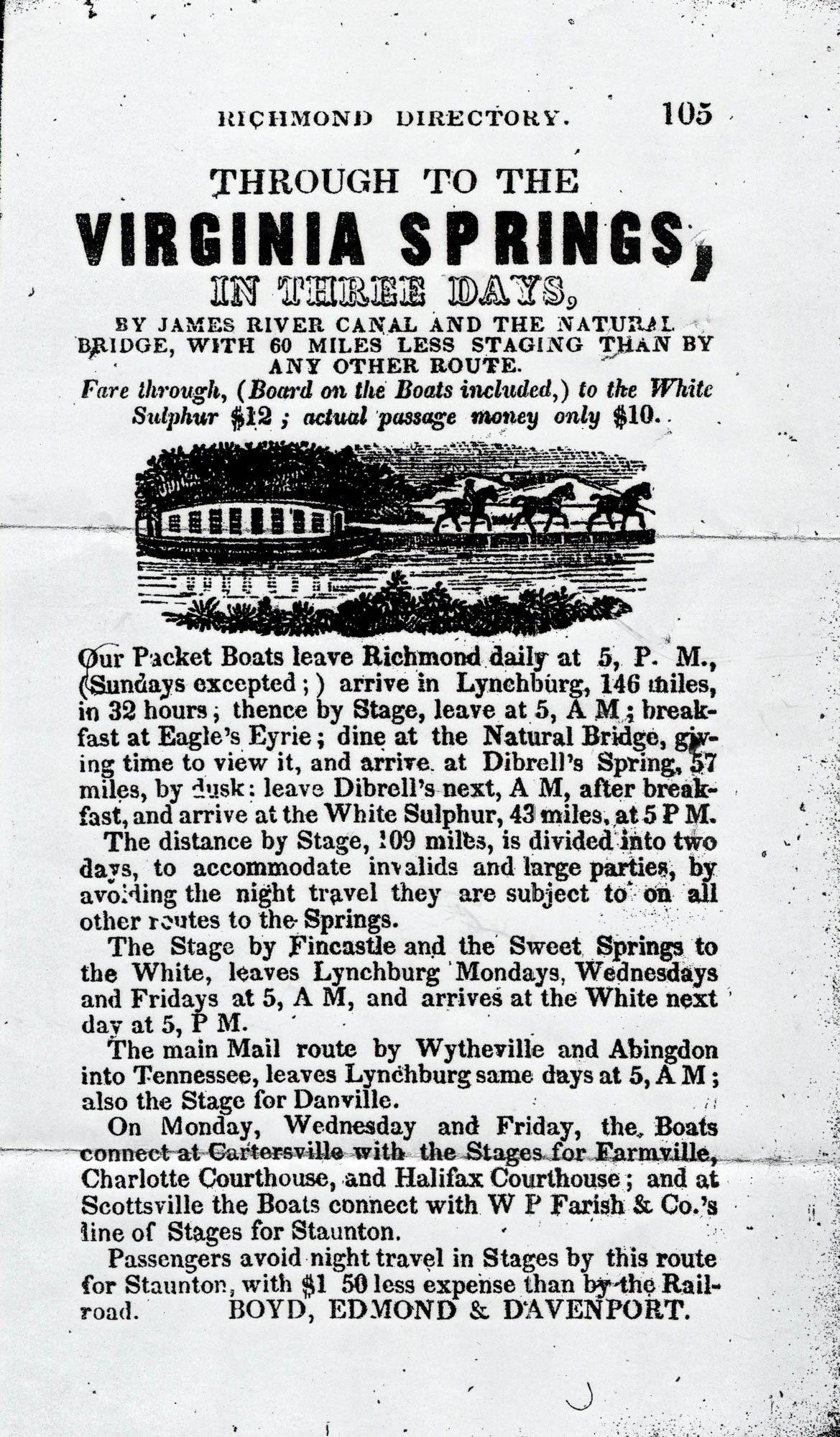
Here is a 1845 BE&D ad in the Richmond Directory, explaining the advantages of traveling on their packet boats west towards Scottsville and Lynchburg and transferring to stagecoaches to the Springs:
Copyright © 2018 by Scottsville Museum
References:
Ellyson’s Richmond Directory 1845 by Henry Keeling Ellyson (Richmond, VA: H.K. Ellyson, 1845)
Cabell’s Canal: The Story of the James River and Kanawha by Langhorne Gibson, Jr. (Richmond, VA: The Commodore Press, 2000)
The Canal on the James by T. Gibson Hobbs, Jr. (Lynchburg, VA: Blackwell Press, 2009).
Top Image Located On: Capturing Our Heritage, CDJH30
JH563cdJH30.tif
JH563cdJH30.jpg
JH563cdJH30.psd
Bottom Image Located On: Capturing Our Heritage, CDJH30
JH565cdJH30.tif
JH565cdJH30.jpg
JH565cdJH30.psd
Leave us a comment or share your story.